A smooth audit starts well before the fieldwork begins. Use this checklist to get your books, records, and team ready, and to avoid last-minute scrambles.

A smooth audit starts well before the fieldwork begins. Use this checklist to get your books, records, and team ready, and to avoid last-minute scrambles.

If audit season makes you groan, you’re not alone. The word “audit” carries a lot of baggage, but a well-planned audit can be one of the most useful things that happens to your organization all year. Here is a practical guide to preparing, drawn from a GGFOA presentation on getting audit-ready.
Most growing businesses reach a point where the books can no longer be a side task. You’re up late reconciling accounts, a part-time bookkeeper is stretched thin, and nobody is sure whether the numbers are right until tax season. Client Accounting Services (CAS) exists for this moment.
Lease and subscription arrangements can be easy to overlook—but keeping an accurate, up-to-date listing of lease and subscription liabilities is an important part of maintaining reliable financial records.
Our firm offers a nonattest service designed to help governmental clients stay organized and keep pace with the requirements of GASB 87, Leases, and GASB 96, Subscription-Based Information Technology Arrangements (SBITAs).

Securing in-kind donations is vital for any non-profit or charitable organization, but just as important is accounting for them properly. In June 2020, the Financial Accounting Standards Board introduced changes to the General Accepted Accounting Principles (GAAP) for documenting and presenting the value of in-kind donations in financial statements. This article provides an overview of the changes and what you need to know.

If your organization solicits or accepts donations in Georgia, there’s a good chance you have a registration requirement you may not know about — and a reporting obligation that scales with how much your nonprofit brings in.
Here’s what Georgia nonprofits need to know.

Rushton Recognized Among the Nation’s Top Accounting Firms by Inside Public Accounting
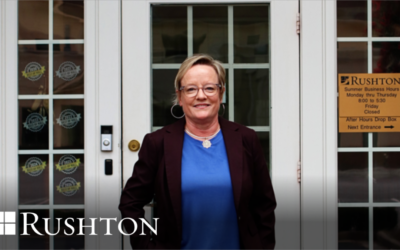
Rushton names Elisabeth Baldwin Managing Partner of Rushton Wealth Management


A Hard Conversation Made Easy Throughout previous stages of life, you might have become accustomed to keeping your financial matters fairly close to the chest. Now, however, would be a good time to start involving your family as you develop and effectuate your estate...

As the 2026 calendar closes in on the October 15th deadline, many plan administrators are unsure if their employee benefit plan requires an audit. Our team can help you determine if your plan requires an audit or if your plan is approaching the audit threshold for the first time. With this knowledge, we can either act quickly and efficiently to ensure your audit is completed before the October 15th deadline or work with you to ensure you are properly prepared for your first audit in 2027.
For most ERISA-covered employee benefit plans (especially 401(k), 403(b), ESOP, and other retirement plans), an independent plan audit is generally required when the plan is considered a "large plan," meaning it has 100 or more participants with account balances at the beginning of the plan year and is required to file Form 5500 as a large plan.
If a retirement plan is approaching 80 participants with account balances, it's wise to start preparing for a future audit.
Once the plan exceeds the applicable threshold and must file as a large plan, audited financial statements must accompany Form 5500.
Getting through an audit means your plan's records — census data, contribution history, trust statements, provider agreements — are already pulled together and fresh in everyone's mind. Rather than setting that information aside once the filing is done, this is actually the easiest moment to use it for something more: a forward-looking review of the plan itself.
Waiting until next fall to think about improvements means starting from scratch again, under the same time pressure. Using the remainder of this year as a springboard means you're getting ahead instead of playing catch-up.
Under the current Department of Labor (DOL) rules for defined contribution plans (such as 401(k) and 403(b) plans), the key count is generally the number of participants with account balances at the beginning of the plan year. This rule became effective for plan years beginning on or after January 1, 2023.
Use the first day of the plan year.
For example:
Include:
Do not count employees who are merely eligible but have no account balance. This is the method that was used to determine the audit threshold prior to January 1, 2023.
As of January 1, 2026, your plan has:
Result: The plan has 105 participants with account balances at the beginning of the year. It would generally be treated as a large plan and require an audit unless it filed as a small plan in the prior year.
The 80-120 rule prevents plans from moving back and forth between small-plan and large-plan status each year.
Once the count exceeds 120, the plan generally must file as a large plan.
| Participants with account balances at beginning of year | Typical Result |
|---|---|
| Fewer than 80 | Small plan, generally no audit |
| 80-120 | Apply the 80-120 rule |
| More than 120 | Large plan, audit generally required |
When testing whether an audit is required, we typically recommend obtaining the participant census from the recordkeeper as of the first day of the plan year and reconciling it to Form 5500 reporting.
The most common mistake is forgetting to include terminated employees and beneficiaries who still have account balances.
If you are unsure whether or not your employee benefit plan requires an audit, or if your plan is approaching the audit threshold for the first time, our team can help determine your best next steps.
Reach out to us today to make sure your plan meets its ERISA audit compliance requirements.
Send us a message on our website or email us at info@rushton.cpa
A smooth audit starts well before the fieldwork begins. Use this checklist to get your books, records, and team ready, and to avoid last-minute scrambles.
If audit season makes you groan, you’re not alone. The word “audit” carries a lot of baggage, but a well-planned audit can be one of the most useful things that happens to your organization all year. Here is a practical guide to preparing, drawn from a GGFOA presentation on getting audit-ready.
Most growing businesses reach a point where the books can no longer be a side task. You’re up late reconciling accounts, a part-time bookkeeper is stretched thin, and nobody is sure whether the numbers are right until tax season. Client Accounting Services (CAS) exists for this moment.
Lease and subscription arrangements can be easy to overlook—but keeping an accurate, up-to-date listing of lease and subscription liabilities is an important part of maintaining reliable financial records.
Our firm offers a nonattest service designed to help governmental clients stay organized and keep pace with the requirements of GASB 87, Leases, and GASB 96, Subscription-Based Information Technology Arrangements (SBITAs).
Securing in-kind donations is vital for any non-profit or charitable organization, but just as important is accounting for them properly. In June 2020, the Financial Accounting Standards Board introduced changes to the General Accepted Accounting Principles (GAAP) for documenting and presenting the value of in-kind donations in financial statements. This article provides an overview of the changes and what you need to know.
If your organization solicits or accepts donations in Georgia, there’s a good chance you have a registration requirement you may not know about — and a reporting obligation that scales with how much your nonprofit brings in.
Here’s what Georgia nonprofits need to know.
Rushton Recognized Among the Nation’s Top Accounting Firms by Inside Public Accounting
Rushton names Elisabeth Baldwin Managing Partner of Rushton Wealth Management
A Hard Conversation Made Easy Throughout previous stages of life, you might have become accustomed to keeping your financial matters fairly close to the chest. Now, however, would be a good time to start involving your family as you develop and effectuate your estate...