A smooth audit starts well before the fieldwork begins. Use this checklist to get your books, records, and team ready, and to avoid last-minute scrambles.


A smooth audit starts well before the fieldwork begins. Use this checklist to get your books, records, and team ready, and to avoid last-minute scrambles.

If audit season makes you groan, you’re not alone. The word “audit” carries a lot of baggage, but a well-planned audit can be one of the most useful things that happens to your organization all year. Here is a practical guide to preparing, drawn from a GGFOA presentation on getting audit-ready.
Most growing businesses reach a point where the books can no longer be a side task. You’re up late reconciling accounts, a part-time bookkeeper is stretched thin, and nobody is sure whether the numbers are right until tax season. Client Accounting Services (CAS) exists for this moment.

Lease and subscription arrangements can be easy to overlook—but keeping an accurate, up-to-date listing of lease and subscription liabilities is an important part of maintaining reliable financial records.
Our firm offers a nonattest service designed to help governmental clients stay organized and keep pace with the requirements of GASB 87, Leases, and GASB 96, Subscription-Based Information Technology Arrangements (SBITAs).

Securing in-kind donations is vital for any non-profit or charitable organization, but just as important is accounting for them properly. In June 2020, the Financial Accounting Standards Board introduced changes to the General Accepted Accounting Principles (GAAP) for documenting and presenting the value of in-kind donations in financial statements. This article provides an overview of the changes and what you need to know.

As the 2026 calendar closes in on the October 15th deadline, many plan administrators are unsure if their employee benefit plan requires an audit. Our team can help you determine if your plan requires an audit or if your plan is approaching the audit threshold for the first time. With this knowledge, we can either act quickly and efficiently to ensure your audit is completed before the October 15th deadline or work with you to ensure you are properly prepared for your first audit in 2027.

If your organization solicits or accepts donations in Georgia, there’s a good chance you have a registration requirement you may not know about — and a reporting obligation that scales with how much your nonprofit brings in.
Here’s what Georgia nonprofits need to know.

Rushton Recognized Among the Nation’s Top Accounting Firms by Inside Public Accounting

Rushton names Elisabeth Baldwin Managing Partner of Rushton Wealth Management


Taxpayers and businesses spend an estimated 7.9 billion hours a year complying with tax-filing requirements, which is worth $413 billion in economic value just to comply with tax regulations.1
As complex as the details of taxes can be, the income tax process is fairly straightforward. However, the majority of Americans would rather not spend time with the process, which explains why half hire a tax professional to assist in their annual filing.2
Remember, this material is not intended as tax or legal advice. Please consult a professional with tax or legal experience for specific information regarding your individual situation.
The tax process starts with income, and generally, most income received is taxable. A taxpayer’s gross income includes income from work, investments, interest, pensions, as well as other sources. The income from all these sources is added together to arrive at the taxpayer’s gross income.
What’s not considered income? Gifts, inheritances, workers’ compensation benefits, welfare benefits, or cash rebates from a dealer or manufacturer.3
From gross income, adjustments are subtracted. These adjustments may include retirement plan contributions, half of self-employment, and other items.
The result is the adjusted gross income.
From adjusted gross income, deductions are subtracted. With deductions, taxpayers have two choices: the standard deduction or itemized deductions. The standard deduction amount varies based on filing status, as shown on this chart:
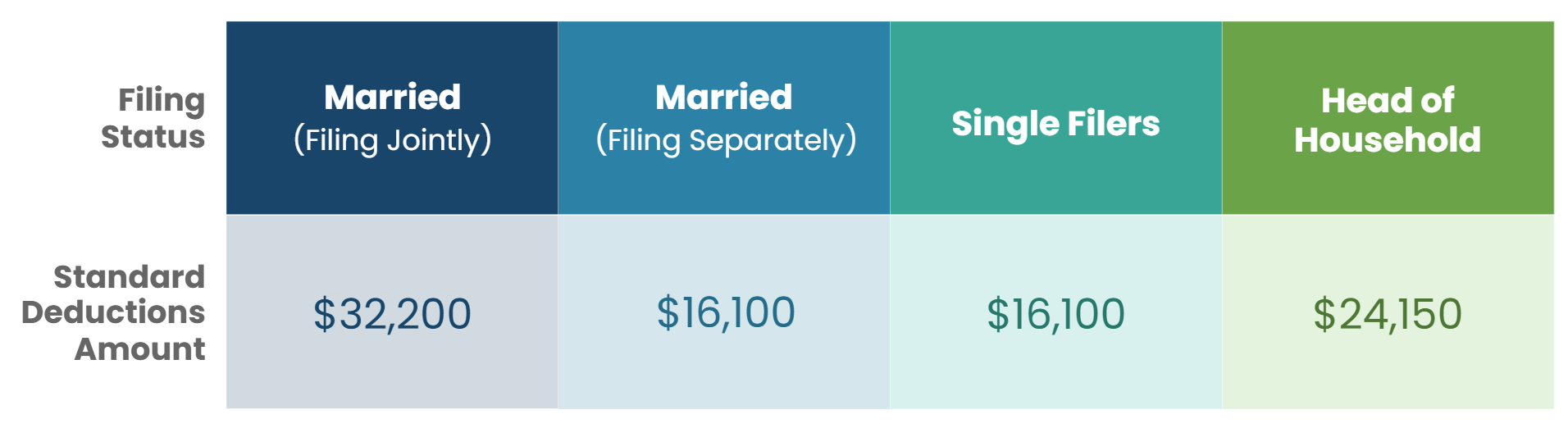
Chart Source: IRS.gov, 2025
Itemized deductions can include state and local taxes, charitable contributions, the interest on a home mortgage, and certain unreimbursed job expenses, among other things. Keep in mind that there are limits on the amount of state and local taxes that can be deducted.4
Once deductions have been subtracted, the result is taxable income. Taxable income leads to gross tax liability.
But it’s not over yet.
Any tax credits are then subtracted from the gross tax liability. Taxpayers may receive credits for a variety of items, including energy-saving improvements.
The result is the taxpayer’s net tax.
Understanding how the tax process works is one thing. Doing the work is quite another.
1. TaxFoundation.org, August 6, 2024
2. IRS.gov, 2025
3. The tax code allows an individual to gift up to $19,000 per person in 2025 without triggering any gift or estate taxes. An individual can give away up to $13,990,000 without owing any federal tax. Couples can leave up to $27,980,000 without owing any federal tax. Also, keep in mind that some states may have their own estate tax regulations. This material is not intended as tax or legal advice. Please consult a professional with tax or legal experience for specific information regarding your individual situation.
4. The mortgage interest deduction is the first $750,000 of the loan for a home and the state and local income taxes deduction is capped at $10,000.
The content is developed from sources believed to be providing accurate information. The information in this material is not intended as tax or legal advice. It may not be used for the purpose of avoiding any federal tax penalties. Please consult legal or tax professionals for specific information regarding your individual situation. This material was developed and produced by FMG Suite to provide information on a topic that may be of interest. FMG Suite is not affiliated with the named broker-dealer, state- or SEC-registered investment advisory firm. The opinions expressed and material provided are for general information, and should not be considered a solicitation for the purchase or sale of any security. Copyright 2025 FMG Suite.
For a comprehensive review of your personal situation, always consult with a tax or legal advisor. Registered Representatives of Cetera firms may not give legal or tax advice.
The strategies mentioned may not be appropriate for all investors. Please consult your financial or tax advisor to determine a strategy that works best for you. Retirement plan withdrawals may be subject to taxation and penalties when withdrawn early.
A smooth audit starts well before the fieldwork begins. Use this checklist to get your books, records, and team ready, and to avoid last-minute scrambles.
If audit season makes you groan, you’re not alone. The word “audit” carries a lot of baggage, but a well-planned audit can be one of the most useful things that happens to your organization all year. Here is a practical guide to preparing, drawn from a GGFOA presentation on getting audit-ready.
Most growing businesses reach a point where the books can no longer be a side task. You’re up late reconciling accounts, a part-time bookkeeper is stretched thin, and nobody is sure whether the numbers are right until tax season. Client Accounting Services (CAS) exists for this moment.
Lease and subscription arrangements can be easy to overlook—but keeping an accurate, up-to-date listing of lease and subscription liabilities is an important part of maintaining reliable financial records.
Our firm offers a nonattest service designed to help governmental clients stay organized and keep pace with the requirements of GASB 87, Leases, and GASB 96, Subscription-Based Information Technology Arrangements (SBITAs).
Securing in-kind donations is vital for any non-profit or charitable organization, but just as important is accounting for them properly. In June 2020, the Financial Accounting Standards Board introduced changes to the General Accepted Accounting Principles (GAAP) for documenting and presenting the value of in-kind donations in financial statements. This article provides an overview of the changes and what you need to know.
As the 2026 calendar closes in on the October 15th deadline, many plan administrators are unsure if their employee benefit plan requires an audit. Our team can help you determine if your plan requires an audit or if your plan is approaching the audit threshold for the first time. With this knowledge, we can either act quickly and efficiently to ensure your audit is completed before the October 15th deadline or work with you to ensure you are properly prepared for your first audit in 2027.
If your organization solicits or accepts donations in Georgia, there’s a good chance you have a registration requirement you may not know about — and a reporting obligation that scales with how much your nonprofit brings in.
Here’s what Georgia nonprofits need to know.
Rushton Recognized Among the Nation’s Top Accounting Firms by Inside Public Accounting
Rushton names Elisabeth Baldwin Managing Partner of Rushton Wealth Management