A smooth audit starts well before the fieldwork begins. Use this checklist to get your books, records, and team ready, and to avoid last-minute scrambles.

A smooth audit starts well before the fieldwork begins. Use this checklist to get your books, records, and team ready, and to avoid last-minute scrambles.
If audit season makes you groan, you’re not alone. The word “audit” carries a lot of baggage, but a well-planned audit can be one of the most useful things that happens to your organization all year. Here is a practical guide to preparing, drawn from a GGFOA presentation on getting audit-ready.
Most growing businesses reach a point where the books can no longer be a side task. You’re up late reconciling accounts, a part-time bookkeeper is stretched thin, and nobody is sure whether the numbers are right until tax season. Client Accounting Services (CAS) exists for this moment.
Lease and subscription arrangements can be easy to overlook—but keeping an accurate, up-to-date listing of lease and subscription liabilities is an important part of maintaining reliable financial records.
Our firm offers a nonattest service designed to help governmental clients stay organized and keep pace with the requirements of GASB 87, Leases, and GASB 96, Subscription-Based Information Technology Arrangements (SBITAs).
Securing in-kind donations is vital for any non-profit or charitable organization, but just as important is accounting for them properly. In June 2020, the Financial Accounting Standards Board introduced changes to the General Accepted Accounting Principles (GAAP) for documenting and presenting the value of in-kind donations in financial statements. This article provides an overview of the changes and what you need to know.

As the 2026 calendar closes in on the October 15th deadline, many plan administrators are unsure if their employee benefit plan requires an audit. Our team can help you determine if your plan requires an audit or if your plan is approaching the audit threshold for the first time. With this knowledge, we can either act quickly and efficiently to ensure your audit is completed before the October 15th deadline or work with you to ensure you are properly prepared for your first audit in 2027.

If your organization solicits or accepts donations in Georgia, there’s a good chance you have a registration requirement you may not know about — and a reporting obligation that scales with how much your nonprofit brings in.
Here’s what Georgia nonprofits need to know.
Rushton Recognized Among the Nation’s Top Accounting Firms by Inside Public Accounting
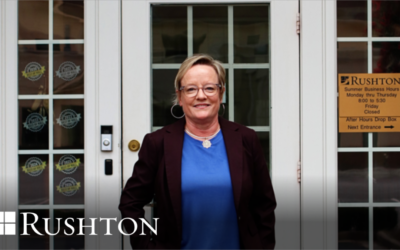
Rushton names Elisabeth Baldwin Managing Partner of Rushton Wealth Management


Money talks is an adage many of us have heard our whole lives. Money is the transactional element of our lives that keeps the world running as we know it, and how you spend your money does say a lot about you.
Value-based purchasing has always been present in our society. We have the right to choose where and how we want to spend our money. You may opt to purchase your son’s soccer cleats from the local sports store rather than the large box store because you want to support your neighbor. Choosing to donate to a church, charity, or political campaign says a lot about what values you want to see in your community. So, why should investing be any different?
When it comes to investing, many people don’t think they have a choice. Whether they are going at it on their own or working with an advisor, most individuals believe that choosing the fund with the highest return is the most important piece of investing. And don’t get me wrong, returns are important. But the point of investing is to grow your wealth so you can go back to the basics – spending it where and how you choose.
So why not invest in a way that is meaningful?
Talking to your advisor and your CPA is a good place to start when deciding on an investment strategy.
Investments are tools to help reach your goals. So before deciding on the best investment strategy, you must first figure out where you are going and what you want before picking an investment strategy. This can be achieved by completing financial planning with your advisor and your CPA.
Securities offered through Avantax Investment ServicesSM, Member FINRA,SIPC. Investment advisory services offered through Avantax Advisory ServicesSM. Insurance services offered through an Avantax affiliated insurance agency.
Rushton and Avantax are not affiliated.
Tax services are provided by Rushton are separate and apart from Avantax.
The strategies mentioned may not be appropriate for all investors. Please consult your financial and/or tax advisors to determine a strategy that works best for you.
The views and opinions presented in this article are those of Rushton and Rushton Wealth Management and not of Avantax Wealth Management® or its subsidiaries.
All investing involves risk, including the possible loss of principal. There is no assurance that any investment strategy will be successful. Past performance is not a guarantee of future results. Neither diversification nor asset allocation can assure or guarantee better performance/profit and cannot eliminate the risk of investment losses in declining markets.
While tax loss harvesting can be a valuable strategy, its effectiveness depends on your individual financial situation and tax circumstances.
Distributions from traditional IRAs and employer sponsored retirement plans are taxed as ordinary income and, if taken prior to reaching age 59 ½, may be subject to an additional 10% IRS tax penalty.
Converting from a traditional IRA to a Roth IRA is a taxable event.
A Roth IRA offers tax free withdrawals on taxable contributions.
To qualify for the tax-free and penalty-free withdrawal or earnings, a Roth IRA must be in place for at least five tax years, and the distribution must take place after age 59 ½ or due to death, disability, or a first-time home purchase (up to a $10,000 lifetime maximum). Depending on state law, Roth IRA distributions may be subject to state taxes.
Tax Free – Income may be subject to local, state and/or the alternative minimum tax.
Real Estate disclosure: Changes in real estate values or economic downturns can have a significant negative effect on issuers in the real estate industry.
There is no assurance that the ESG investing strategy or techniques employed will be successful. Past performance is not a guarantee or reliable indicator of future results.
A smooth audit starts well before the fieldwork begins. Use this checklist to get your books, records, and team ready, and to avoid last-minute scrambles.
If audit season makes you groan, you’re not alone. The word “audit” carries a lot of baggage, but a well-planned audit can be one of the most useful things that happens to your organization all year. Here is a practical guide to preparing, drawn from a GGFOA presentation on getting audit-ready.
Most growing businesses reach a point where the books can no longer be a side task. You’re up late reconciling accounts, a part-time bookkeeper is stretched thin, and nobody is sure whether the numbers are right until tax season. Client Accounting Services (CAS) exists for this moment.
Lease and subscription arrangements can be easy to overlook—but keeping an accurate, up-to-date listing of lease and subscription liabilities is an important part of maintaining reliable financial records.
Our firm offers a nonattest service designed to help governmental clients stay organized and keep pace with the requirements of GASB 87, Leases, and GASB 96, Subscription-Based Information Technology Arrangements (SBITAs).
Securing in-kind donations is vital for any non-profit or charitable organization, but just as important is accounting for them properly. In June 2020, the Financial Accounting Standards Board introduced changes to the General Accepted Accounting Principles (GAAP) for documenting and presenting the value of in-kind donations in financial statements. This article provides an overview of the changes and what you need to know.
As the 2026 calendar closes in on the October 15th deadline, many plan administrators are unsure if their employee benefit plan requires an audit. Our team can help you determine if your plan requires an audit or if your plan is approaching the audit threshold for the first time. With this knowledge, we can either act quickly and efficiently to ensure your audit is completed before the October 15th deadline or work with you to ensure you are properly prepared for your first audit in 2027.
If your organization solicits or accepts donations in Georgia, there’s a good chance you have a registration requirement you may not know about — and a reporting obligation that scales with how much your nonprofit brings in.
Here’s what Georgia nonprofits need to know.
Rushton Recognized Among the Nation’s Top Accounting Firms by Inside Public Accounting
Rushton names Elisabeth Baldwin Managing Partner of Rushton Wealth Management